


17 Apr “Small Wonders” Casting a Spotlight on South Devon’s Coastal Wildlife
Taking a closer look at some of the small things that make South Devon’s coastline special.
Skip Ahead:
With winter now behind us, South Devon’s insect inhabitants are returning to the fields and skies! Amongst them, a few newcomers have joined the mix.
Created with local artists and residents, our ‘Small Wonders’ are a series of installations and artworks designed to celebrate the unique wildlife of our coastline and encourage visitors to reflect on the beauty and importance of nature around us.
You can visit our Small Wonders, two of which can be found in their new homes on Bolberry Down and Pudcombe Cove from now until October half term, and the third – a recorded poem by local artist Tom Stockley – is available permanently on our website.
Creating a Buzz
The Willow Bees of Bolberry Down
By Vivienne Turner with the help of local residents
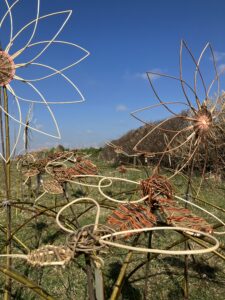
‘Creating a Buzz’ is an installation of 36 willow carder bees and flowers on Bolberry Down, created by willow-artist Vivienne Turner with the help of local community members.
The Brown-banded Carder Bee is an all ginger bumblebee species, that requires open flower-rich grasslands where wildflowers such as clovers, Bird’s-foot Trefoil and knapweeds are plentiful. It has declined due to the loss of this habitat, including along the South Devon coast, where wildflower-rich grasslands are now few and far between.
It was thought to be extinct in Devon but was found near Prawle Point in the South Devon AONB last summer, recorded for the first time since 1978.
Flying between May and September, they are typically solitary insects, so please allow for some artistic license.
Make the most of the Devon sunshine and enjoy the sweeping coastal views when you go visit, ‘Creating a Buzz’ at Bolberry Down.
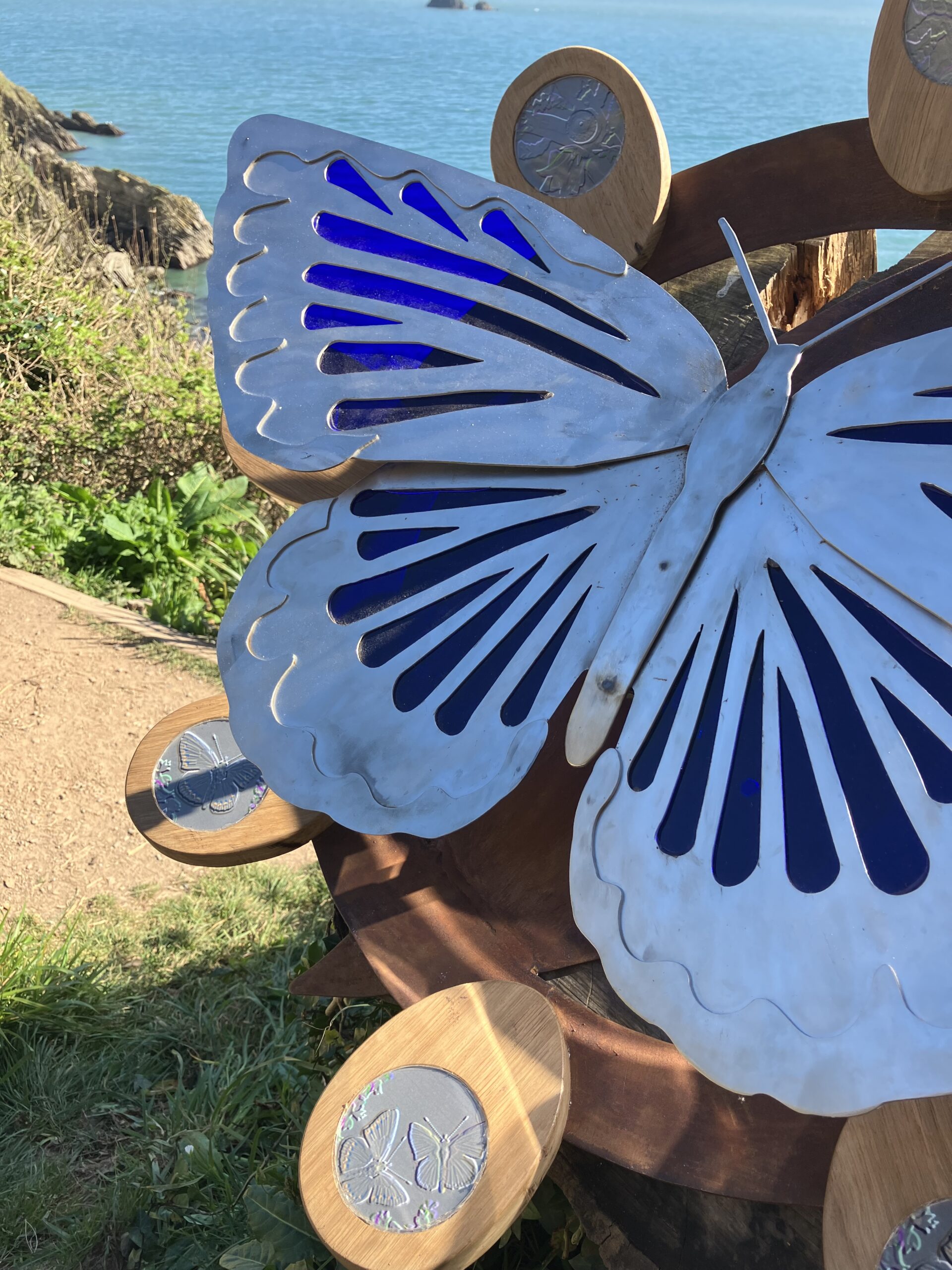
Silver Studded Blue
Pudcombe Cove, Coleton Fishacre

The Silver-studded Blue (Plebejus argus) is a rare butterfly of southern England and Wales, seen flying between June and August on heathland, sand dunes and chalk or limestone grassland.
It is a small butterfly with a wingspan of around 30mm, and gets its name from the metallic blue reflective scales on it wings (the males are bluer than the females).
Silver-studded Blues live in close-knit communities. Adult butterflies only live 4-5 days and rarely fly more than 50m from their nest
site, so they need their food plants nearby! Preferred food plants of the caterpillars include heathers, gorse, birds foot trefoil and
common rock rose.
This butterfly has a strong relationship with black ants. Females lay their eggs close to a black ants’ nest and
when the caterpillars hatch, the ants carry them into the nest and ‘farm’ them for sugars which the larvae excrete in high quantities.
In return, the ants then escort the caterpillars outside at dusk to feed. The caterpillars pupate in the tunnels of the nest and then,
when the time comes, the ants will accompany the emerging butterflies back up to the surface. A real example of helping one
another!
Sadly, this beautiful butterfly has undergone a major decline and is now considered ‘vulnerable’. It is found on the South Devon
coast near to Salcombe, and we are working with partners to restore and enhance the habitat it needs to thrive.
Burn The Curtain are an outdoor arts company based near Exeter. They have a long-standing commitment to
environmental issues and getting audiences out into special areas of the countryside. For this work, artist, Joe Hancock,
collaborated with fabricator Jules Webb and Illustrator Lisa Brooks. Find out more about their work at www.burnthecurtain.co.uk.
With thanks to Pebblebed Heaths Conservation Trust for loaning the lifecycle images, and to the National Trust for hosting this piece.
The Aquanaut
Poem by Tom Stockley
The film shows the iconic Prawle Point, precious habitat of the Long Horned Mining Bee, with Tom reciting his poem, ‘The Aquanaut’, specially commissioned for Life on the Edge.
Tom reflects on the process,
” I was really pleased to be asked by Doorstep Arts and South Devon National Landscape to engage with this project and respond with a commissioned poem. I’ve grown up in Torbay and have a complex and changing relationship with this part of the world – I’ve been surrounded by its natural beauty, but also felt the loneliness of living here, disconnected from the busyness of the wider world. I think that’s why I could relate to the name and theme of this conservation project; Life on the Edge. For me it’s about those spaces in between, liminal places where other worlds are formed in the landscape.”
“Visiting East Prawle one consistent theme was that of perspective. The tiny, fragile worlds going on above and beneath us that many people never see. I wanted to focus on this, because on the flipside you have huge concepts of shifting geology, natural history and environmental concerns that I think are best interpreted through the perspective of something much smaller. I don’t think anything holds that insight better than the symbol of the project, the Long Horned Mining Bee.”
“As we explored the area and spoke about its significance, one image that came up was the idea of East Prawle as a terrestrial reef – a landscape that had once been under water but still embodies those vivid, otherworldly qualities of a tropical sea bed. As someone with a lifelong passion for invertebrates, I’m constantly inspired and amazed by the colours, movements and histories of these tiny worlds. To capture this, I’ve reimagined the Long Horned Mining Bee as a deep sea diver – floating over this strange and beautiful world. I hope it captures some of these qualities – the immense beauty as well as the fragility of this special part of our home, and the responsibility we have to appreciate, respect and protect it.”
Explore more of Tom’s work, here.

