


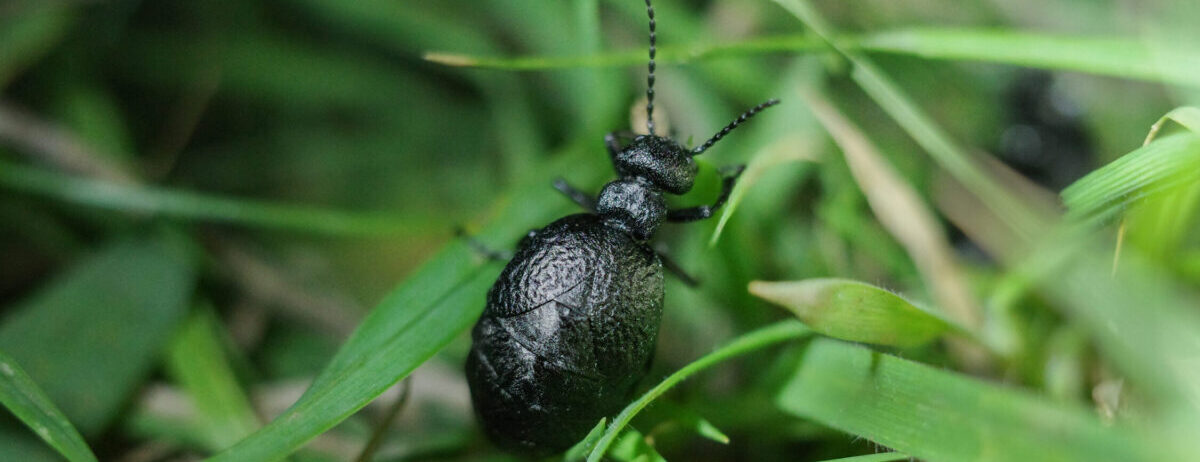
26 Jan Mediterranean Oil Beetles in South Devon
Oil beetles are distinctive invertebrates with an unusual life history. Termed ‘blister beetles’ in other parts of the world, they are named for the oil-like substance they secrete from their joints when threatened, which puts off any potential predators.
These charismatic beetles can be up to 3.5cm long. Generally black in colour, though with some species tinted blue or violet, they have short wing cases and, in the case of the females, often bulbous abdomens.
You may have spotted one of the more locally common species, the Black Oil Beetle (Meloe proscarabaeus), out on coastal walks in spring, the females’ heads down in the ground and their abdomens up as they dig burrows in which to lay their eggs.
Something of a Mystery – Meloe mediterraneus
There are five species of oil beetle found in the UK, with another four classed as extinct. This winter, Life on the Edge (LoTE) volunteers helped with surveys along the South Devon coastline, searching for one of the most elusive of these, the Mediterranean Oil Beetle (Meloe mediterraneus).
Referred to by a 2002 British Wildlife article as “something of a mystery in Britain”, the Mediterranean Oil Beetle had been assumed extinct for over 100 years. Difficulties with identification due to its similarity to another species the Rugged Oil Beetle (Meloe rugosus) are thought to have contributed to its lack of documentation.
In 2012 as part of a project run by Buglife, local naturalist and ecologist John Walters rediscovered the species on the South Devon coastline. Its rediscovery, alongside the new understanding that they are most active at nighttime, has prompted more searches in their preferred coastal grassland habitat to build a picture of how the species is using the landscape, and to tailor conservation actions to its very particular life history.
Bees and Beetles
Oil beetles are kleptoparasites, animals that take food or prey from other animals. They are parasites of solitary mining bees, acting as nest cuckoos. Adult Mediterranean Oil Beetles will emerge from late autumn through winter to feed on nearby vegetation and look for a mate. Upon mating, the female digs a burrow in the soil where she lays up to 1000 eggs. The larvae, called triungulins, hatch the following spring.
They are very small (Mediterranean Oil Beetle triungulins are about 0.8mm long) and very active, climbing up the nearest flowers and hooking themselves onto any insect that lands to pollinate it. Ideally this is a solitary mining bee, and they hitch a ride back to its nest. There the triungulin detaches and eats the bee’s egg and pollen store before pupating into its adult form over several months. It then emerges in autumn/winter, ready to start the lifecycle all over again.
Unfortunately, the abundance and diversity of solitary mining bees is in decline across the country. As the oil beetles’ life cycle is so intertwined with that of the bees, this is thought to be a significant contributor to their decline in numbers, but also a clear opportunity for conservation.
Species-rich grasslands are vital habitats for solitary bees, as are the friable coastal soils that mining bees use to nest. However, climate change, agricultural intensification, and loss of habitat to farming, forestry, and urbanisation has eaten away at these precious habitats – since the 1930s, 97% of species-rich grasslands across England and Wales have been lost.
Oil beetles have fascinating adaptations that help them through their lives. The females can lay up to 40,000 eggs in batches across their short lifetime of about two months – necessary numbers when the triungulins are taking a chance on whatever lands on the flowers they climb up!
Mediterranean Oil Beetles are also, following their namesake, prevalent in southern Europe and North Africa – the southern edge of the UK is the northernmost part of their range. Encountering predators and hot weather, the beetle is adapted so that the adults are mostly nocturnal and active over the cooler months of the year.
Night-time Surveys
We’ve been out onto the coast on surveys six nights this winter with our brilliant volunteers and found a total of 41 Mediterranean Oil Beetles across four sites – and excitingly, even discovered a brand-new population!
Walking the coast path at night is an experience in itself – hearing the waves crashing below and experiencing real dark skies with the Milky Way glowing above on clearer nights is amazing.
As well as oil beetles, we’ve seen lots of fungi, ground beetles, a type of dung beetle called the Common Dor (Geotrupes stercorarius), Devil’s Coach-horse (Ocypus olens), the beautifully iridescent gold Banks’s Leaf Beetle (Chrysolina banksii) and the Ridged Violet Ground Beetle (Carabus problematicus).
A huge thanks to our volunteers who have braved the dark and cold to help us search!
The survey recordings are available on iRecord, a freely available resource that anyone can upload their sightings to. Sightings are checked by experts, and the datasets are used by projects and national recording schemes.
LotE will use the survey data to target habitat restoration works like planting wildflower species needed by solitary bees, and bee bank building to increase the habitat available for nesting. If we can restore bee numbers, we can restore oil beetles along with them. Healthy bees mean healthy beetles.
The story of the Mediterranean Oil Beetle shows the power of people getting to know the amazing wildlife of the landscape on their doorstep – from rediscovering this insect for the first time in 100 years to finding new populations!
Who knows what assumed-to-be extinct creatures are quietly living out their lives, just waiting to be spotted! Anyone can get involved in bringing these species back from the brink – keep an eye out on our website and sign up to our mailing list to get involved in future surveys. The work of our volunteers directly supports our conservation actions, so every person and any hour that can be spared counts!
This blog post was written by our conservation trainee Amy!
Buglife identification guide: https://cdn.buglife.org.uk/2019/08/Oil-Beetle-national-survey-leaflet-for-web_5-species.pdf

