


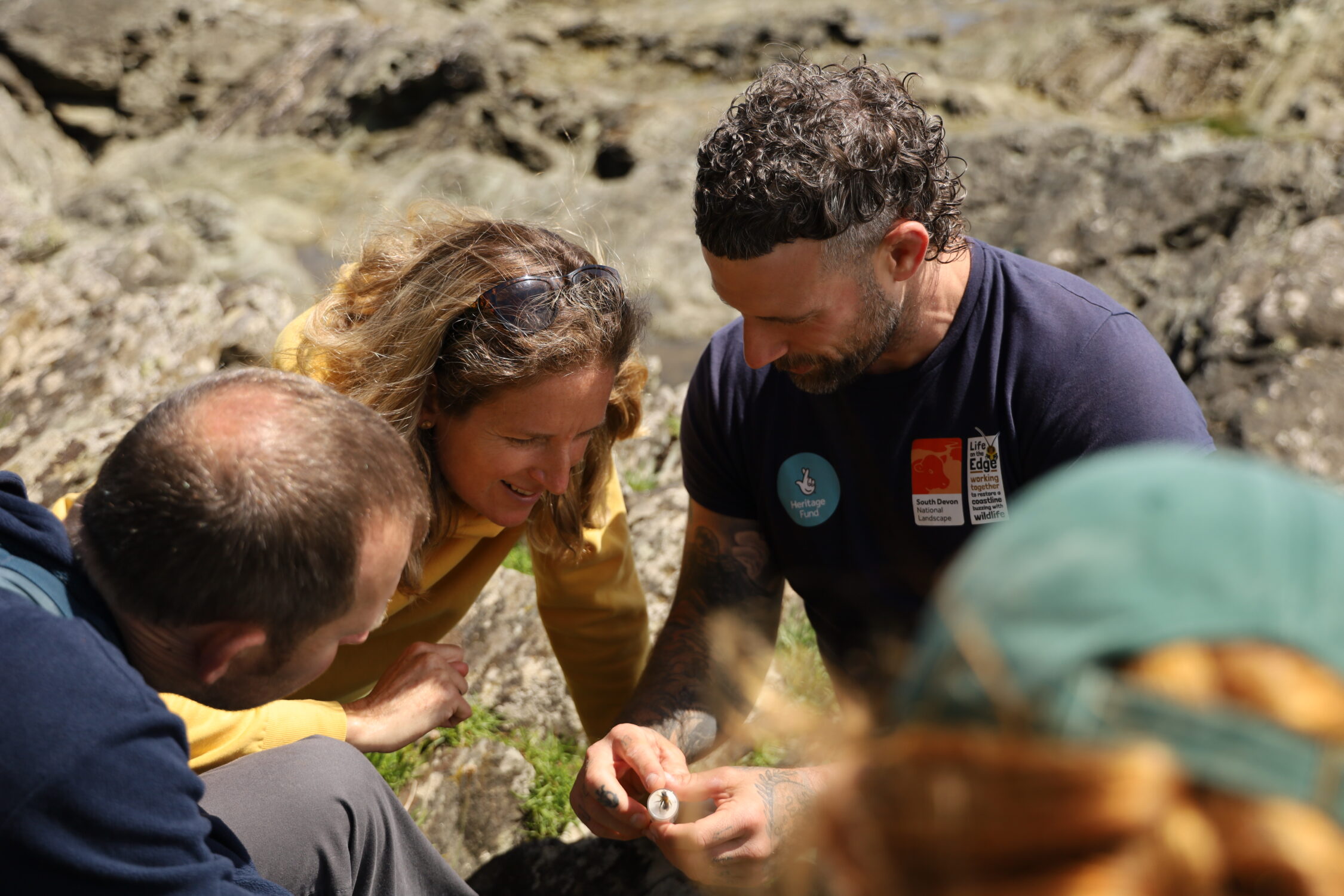
20 Jul Working with Life on the Edge – My Journey
By Michael O’Shea, Life on the Edge Conservation Trainee
I’ve always been fascinated by the natural world. As a wild child, spending time outdoors gave me somewhere to channel my curiosity while grounding what was, at times, a rather chaotic energy. Looking back, I realise those early experiences in nature helped shape the path I’ve found myself on today.
My journey into the world of insects began while growing up in a broken home. During those difficult years, my grandfather nurtured my fascination with wildlife by dropping off my monthly copy of Bugs magazine and taking me to an invertebrate convention that left me completely wide-eyed. I still remember walking around surrounded by giant stick insects, exotic beetles, spiders and mantises, amazed by the sheer diversity of life. You can imagine my mum wasn’t too impressed when I came home with two Madagascan hissing cockroaches!
As I grew older, insects remained something I admired, but I never imagined they could become a career. Coming from a working-class background and not following the traditional academic route, I didn’t even know there was a name for the study of insects, entomology, let alone that there were jobs dedicated to studying and conserving them.
Then came the twist of fate that reinvigorated a deep-rooted passion that lay dormant for a while.
One afternoon, while walking along a riverbank with my best friend, flashes of metallic green caught my eye on the sandy bank. They were Cicindela campestris, the Green Tiger Beetle, and I couldn’t believe how stunning they were. Their iridescent bodies shimmered in the sunlight, and their oversized jaws made them look like tiny prehistoric predators.
That moment changed everything.
I suddenly realised just how many incredible insects live right here in Britain, many of them incredibly rare and dependent on very specific habitats, geology and food plants. I wanted to see as many of them as I could, and before long, the road trips had begun. Every weekend became another adventure in search of species I’d only ever seen in books.
Although I was coming to it later than many people, I decided in 2021 that I wanted to become an entomologist and contribute to the conservation of these extraordinary creatures. There were obvious gaps in my scientific knowledge, so I took what felt like the biggest leap of my life and enrolled on a Biosciences degree. It gave me a solid grounding in ecology, genetics, evolution, biochemistry and the scientific principles that underpin conservation.
After graduating, I discovered the Life on the Edge project.
As soon as I read about the partnership, which includes the incredible charity Buglife, I knew it was something I wanted to be part of it. The project works across South Devon’s coastline, from Wembury to Berry Head, conserving and restoring coastal habitats for 30 priority invertebrate species. Knowing that much of this work was happening right on my doorstep made the opportunity even more exciting.
I applied for both the Community and Conservation Trainee roles, hoping that one of them might open the door into the conservation sector.
Thankfully, it did.
In 2025, I was delighted to be offered the Community Trainee position, where I had the privilege of being mentored by Stuart Riddle. The role gave me the opportunity to develop my confidence in public engagement, deliver nature-based activities and, perhaps most importantly, tell the fascinating stories behind some of our rarest coastal invertebrates. Sharing these stories with schools, families and members of the public reminded me just how inspiring these remarkable creatures can be.
By the end of the placement, I knew I wanted to deepen my ecological knowledge even further.
So, when the opportunity arose to apply for the Conservation Trainee role, I couldn’t resist. I wanted to get into the finer details of habitat management, species surveying and understanding the complex relationships between invertebrates, their food plants and the landscapes they depend upon.
Fast forward to spring 2026 and life is busier than ever.
Alongside studying for an MSc in Entomology, I was fortunate enough to be appointed as the Life on the Edge Conservation Trainee. Every Friday, I have the pleasure of leading our fantastic volunteers and Ranger apprentices on survey days. Guided by Conservation Officer Sam Skevington, we head out along South Devon’s spectacular coastline searching for some of our rarest target species, from the elusive Moon Spider to the iconic Long-horned Bee, proudly featured on the Life on the Edge logo.
Although our surveys focus on these priority species, every outing reveals a wealth of other invertebrates, and no two Fridays are ever the same. While I’ve learned a huge amount over the last few years, I certainly don’t know everything, and that’s one of the things I love most about this work. Our volunteers bring an incredible range of knowledge and experience, and many have taught me just as much as I’ve taught them. Conservation really is a team effort.
Expanding the known range of the Moon Spider
One of this year’s most exciting discoveries has been helping to expand our understanding of the remarkable Moon Spider.
Very little is known about the complete life history of this incredibly fast ground spider, but we do know that it is a specialist predator of ants and is restricted to just three known sites in the UK, one of which is Prawle Point.
This year, our surveys have shown that the species occupies a much larger area than previously recorded. We’ve found individuals further along the wave-cut platforms at East Prawle, with additional sightings along the coastal path between Prawle Point and Gammon Head. Every new record helps us build a clearer picture of the species’ distribution and provides valuable information for its future conservation.
New nesting sites for the Long-horned Bee
We’ve also made some fantastic discoveries involving one of South Devon’s most charismatic insects, the Long-horned Bee.
This striking solitary mining bee is instantly recognisable, particularly the males with their extraordinarily long antennae. In Britain, the species is largely confined to the south coast and has very specific habitat requirements. It nests in soft, south-facing earth or cliff faces and relies heavily on flowers from the pea family, including Kidney Vetch, Bird’s-foot Trefoil and Everlasting Pea, to collect pollen for the food stores that nourish its developing larvae.
As coastal habitats become increasingly fragmented, suitable nesting areas and food sources can become scarce, making conservation work more important than ever.
Thanks to the dedication of our volunteers and Ranger apprentices, we’ve discovered several previously unrecorded nesting areas with active bee populations. These include Leak Cove in East Portlemouth, Woodcombe Beach near East Prawle and, more recently, Long-horned Bees recorded on the wing at Pudcombe near Dartmouth.
These new records will help guide future habitat management, allowing our Conservation Officer, Sam Skevington, to ensure these newly discovered populations receive the protection and management they need to thrive.
Join us on a Friday survey
One of the best parts of this role has been sharing these experiences with others.
If you’d like to get involved, we’d love to welcome you along to one of our Friday survey sessions. You don’t need any previous ecological or entomological knowledge, just an enthusiasm for wildlife and a willingness to learn. We’ll introduce you to the target species for the day, explain how we carry out surveys and help you discover just how diverse and fascinating our coastal invertebrates really are.
Whether you’re looking to learn something new, meet like-minded people or simply spend a day exploring some of South Devon’s most beautiful landscapes, there’s a place for you in our friendly team.
Every new volunteer helps us gather valuable records, improve our understanding of these remarkable species and contribute directly to their conservation.
I hope to see you on the coast soon.
Michael O’Shea
Conservation Trainee, Life on the Edge
To sign up for our Life on the edge Surveys please email: lote@southdevon-nl.org.uk

