


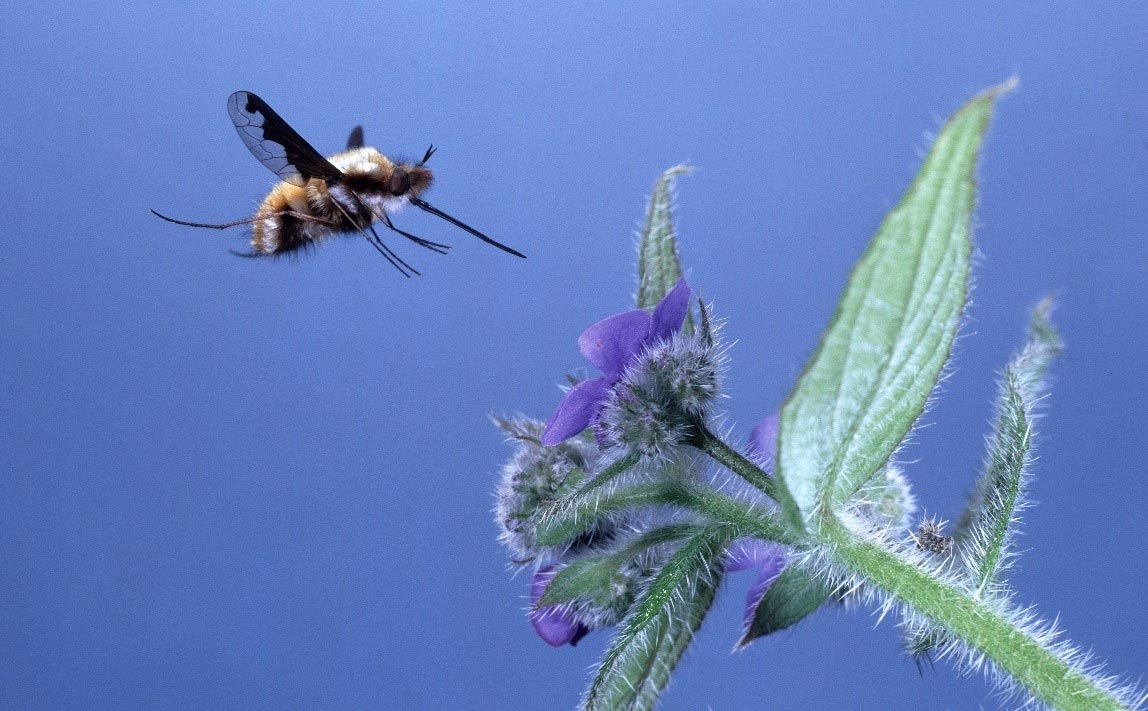
27 Mar Bee-flies – Spring’s Bumbling Buccaneers
As the first warm breezes of spring unfurl across South Devon’s hedgerows and , an extraordinary cast of invertebrates awake from their winter slumber. Among these, some aerial acrobats take to the skies, the bee-flies. These enchanting insects, clad in soft fuzz and armed with long sword-like proboscises, are at once familiar and mysterious. Often mistaken for bees in flight, they are in fact members of the fly family Bombyliidae, masters of mimicry and mischief. With their rapid, darting movements and high-pitched hum, bee-flies stand out from the crowd. They flit from blossom to blossom, sipping nectar while servicing the floral riches of Primroses, Violets, and early wild blooms. Yet behind their benign appearance, lies a remarkable, complex, and almost piratical ecology.
The sword-like proboscises of bee-flies serve a dual purpose, they allow bee-flies to reach nectar in deep flowers, but more deviously to stab through the base of flowers as a quick and dirty shortcut to the nectar. This heist fails to pollinate the flower, voiding the symbiotic relationship, hence why they are sometimes referred to as ‘nectar thieves’.
Flowers are not the only victims of bee-flies’ burglary, as their larvae develop within the burrows of solitary bees. A female bee-fly scoops up dust with her abdomen, to coat, protect, and camouflage her eggs. She then flies over solitary bee nest holes and flicks her eggs toward the unwitting bee’s burrow. Hatching bee-fly larvae wriggle to the burrow journeying into underground nests to gorge upon all the bee’s hard-earned treasure, the pollen provisioned for its larvae. The bee-fly larva then undergoes a second metamorphosis. In this second, much larger, stronger, and hungrier larval state, the bee-fly larva sets about devouring all the helpless solitary bee larvae until it is the only grub remaining in the nest.
With their roguish penchant for sword wielding thievery and rather unscrupulous lifestyles, you may now see why I call them buccaneers. With their mix of beauty and biological intrigue, bee-flies truly are engaging characters in the rich tapestry of life that makes our spring countryside so captivating.
Picture 1: Dark-edged Bee-fly (Bombylius major) ©Kim Taylor
The Dark-edged Bee-fly (Bombylius major) is the most common and frequently seen bee-fly in South Devon. Robed in warm, brownish fuzz with a striking dark band along the front edge of its wings, this charismatic species announces itself with its high-pitched buzz on sunlit days from March through to June.
By contrast, the Dotted Bee-fly (Bombylius discolor) is a much less common sight. Slightly smaller than the Dark-edged Bee-fly, its wings are adorned with delicate spots which become more visible when it pauses to rest. The Dotted Bee-fly can be glimpsed among open grasslands, garden margins, and flowery spots bathed in spring sunshine. On the sun-warmed grasslands of South Devon, between the headlands of Bolt Head and Start Point, and in the quiet, sheltered valleys that fold gently toward Brixham, there are records of this remarkable creature.
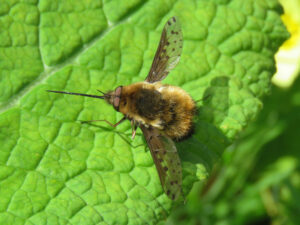
Picture 2: Dotted Bee-fly (Bombylius discolor) © Steven Falk
To the casual passer-by it might seem little more than a fleeting blur, a tiny chestnut-coloured puff of fur that darts through the air and vanishes as quickly as it appeared. But this bee-fly leads a life intricately bound to the fate and fortunes of mining bees, in particular the Yellow-legged Mining Bee (Andrena flavipes) and the Ashy Mining Bee (Andrena cineraria). If one were to pause beside a patch of sandy soil where these bees have made their burrows and sit quietly in the warmth of the springtime sun, patience might be rewarded. For from nowhere, a female Dotted Bee-fly may appear, a hovering, darting, tiny, chestnut fuzzball alive with purpose.
Yet encounters such as these are becoming rarer. As wildflower-rich grasslands have been lost, so too have the mining bees that depend upon them, and with them the Bee-flies. Today the Dotted Bee-fly is considered Nationally Scarce, a reminder that even the smallest lives depend upon a delicate web of relationships. And so, when one is seen here in South Devon, it is more than a curiosity. It is a small treasure and a living testament to the quiet, enduring complexity of the landscape that still remains.
Make a Difference
For those who cherish the unfolding drama of nature on their doorstep, South Devon provides a unique stage to witness and contribute to this story. The Life on the Edge project is actively working to safeguard and restore habitats for a host of rare invertebrates along the South Devon coast, and Dotted Bee-flies are included among the species whose distributions we are eager to understand better. Recording your own sightings of bee-flies is one of the most powerful ways you can help. Photograph what you see, note the date and location, and share your records through citizen science platforms such as iRecord.
Every piece of data enriches our understanding of these remarkable insects and supports conservation efforts that connect swathes of wildflower corridors across the landscape. Come spring, when the bee-flies buzz into view, be ready to look, listen, and record, or join us surveying, for in every sighting lies a story of connection between people and the wild world around them.
LotE is in its second year of a five-year project. To find out more see: Life on the Edge.[/vc_column_text][/vc_column][/vc_row]

