


23 May Walking with Glow Worms: Ecology and Night Walks in South Devon
Glow Worms:
Lampyris Noctiluca
Skip Ahead:
Micheal O’Shea – Communities’ Trainee
Alarming Results of the Bugs Matter Survey
Driving through the Devon countryside of a fine spring evening, you’re bound to notice a smattering of small marks speckling your windscreen.
These ‘Bug Splats’ are recorded in a yearly citizen-science survey Bugs Matter run by Buglife and Kent Wildlife Trust.
By recording the number of squashed insects on drivers’ numberplates, the survey tracks changes to the abundance of flying insects up and down the UK.
This year’s Bugs Matter results are alarming: a decrease of over 60% since 2021.
The use of pesticides, habitat loss, and climate change are all wreaking havoc on insect populations, with serious impacts for the health and functioning of our ecosystems and knock-on effects for humans.
Life on the Edge

While this all sounds very gloomy, projects such as Life on the Edge (LotE) are a beacon of hope for the insects living along the South Devon Coast.
LotE encourages people to engage with the natural wonders in our landscape and take practical action to protect them, building a sense of pride within local communities and ensuring a brighter future for our precious wildlife.
We encourage you to get involved in our upcoming events, where you can learn about the key species we are working to protect.
Glow Worms (Lampyris Noctiluca)
One such species is the Glow Worm, Lampyris Noctiluca.
Where to find a Glow Worm:
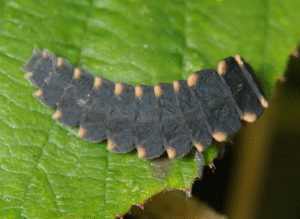
The Glow Worm, as it is commonly known, is in fact not a worm – but a beetle. The adults can be found for a short period during June and July – usually residing in meadows, grassland, and hedgerows, or hiding under rocks or deep in grassy tussocks.
To catch a glimpse of these wonderous insects, choose a warm, still night with a crescent moon – Glow Worms are less likely to glow under a full moon.
Take a torch for safety, but try to resist using it as much as possible. allow your eyes to adjust to the dark. This will help you distinguish the faint green-yellow glow of the beetles’ light.
Lifecycle
Glow Worms start their lifecycle as an egg, from which the larvae hatch.
At this early stage, the immature beetle is a ferocious hunter – feeding on slugs and snails. The larvae latch onto their prey using their mandibles and deliver a bite along with digestive enzymes. Then, avoiding the slug’s secretions, the larva cling to its prey and devour the liquified internal contents. Bon appetite!
This larval stage lasts for approximately 2-3 years.
During this time, the developing larva oscillates between periods of hunting in the summer and over-wintering, until eventually pupating and emerging as an adult beetle.
Appearance
Adult Glow Worms, which emerge in June, lack any feeding mouth parts. Good news for slugs and snails!
This is because, like many insects, the adult stage of Glow Worm lifecycle only lasts a couple weeks for the sole endeavour of finding a mate and reproducing.
The male and female adult Glow Worms look quite different from each other. The males look like other beetles, with brown elytra (wing cases) that protect their wings. The females are wingless, are larger than the males and are more like larvae in their appearance.
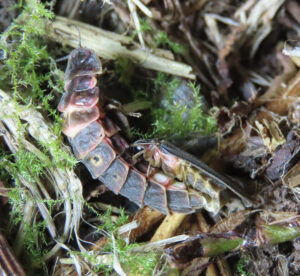
Image C. John Walters: A Female (left) and Male (right) mating pair of Glow Worms.
Bioluminescence
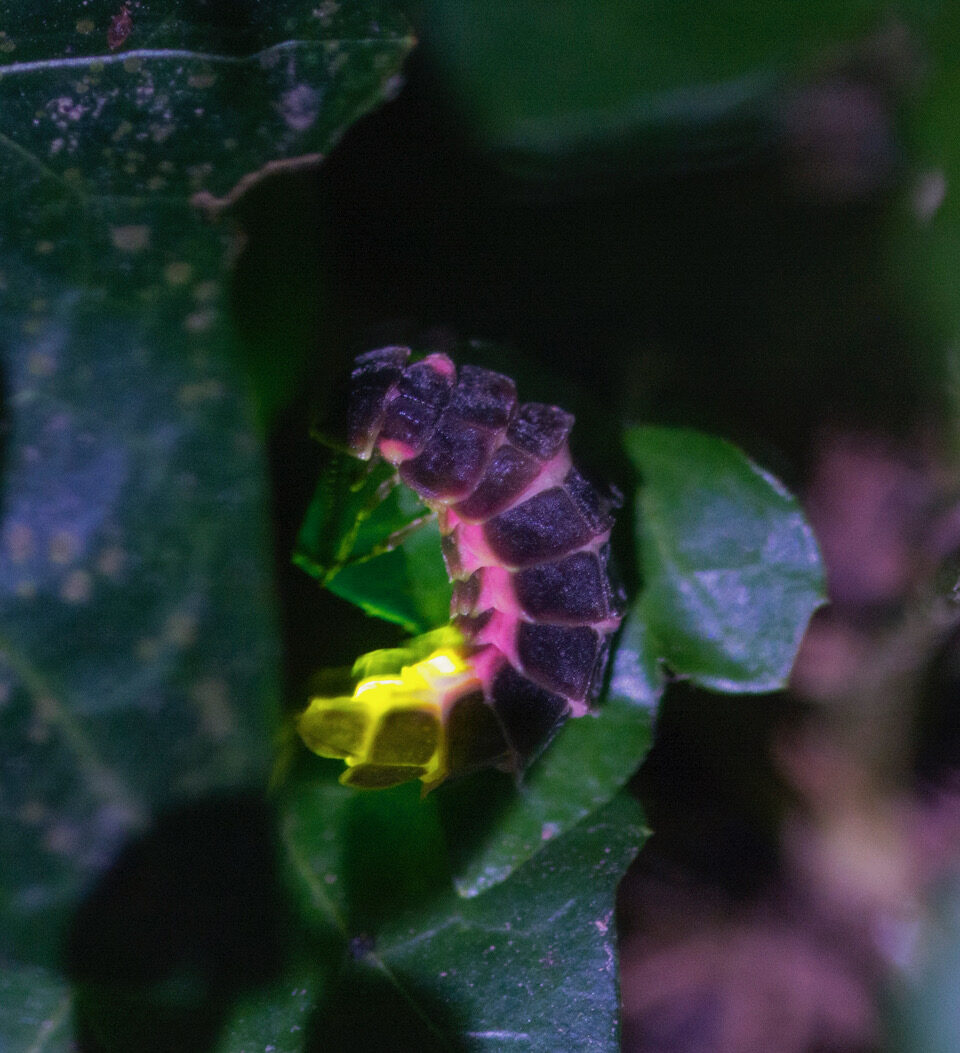
To increase their chances of successfully finding a mate, Glow Worms go a step further, using bioluminescence to make themselves seen!
Males and females both emit light from the final segment of their abdomen, using their glow to entice the opposite sex. However, the wing-less females emit a much brighter light, helping the males seek her out.
This magical twinkle in the night is caused by a chemical reaction involving the mixing of a molecule, luciferin, and oxygen and the introduction of an enzyme (luciferase), resulting in a yellow-green photon spark.
By controlling the oxygen supply to the light-emitting membranes in their abdomen, glow worms can regulate the reaction, giving them the ability to turn the light show on or off like the flick of a switch.
A Species Under Threat:
Glow Worms are very reliant on light to enable them to find a mate and reproduce. As a result they are sensitive to light pollution, and where artificial light is used in towns and the countryside, this has reduced the numbers of Glow Worms, and in some places they have become locally extinct.
Our partners at Buglife are campaigning to reduce harm caused by light pollution on wildlife. Click here to find out more about light pollution and take the pledge: ‘Curtains for Light Pollution‘!
See for Yourself
Witness this phenomenal light show for yourself by signing up to our Glow Worm Walks. They are suitable for anyone over the age of 14, who is confiodent walking onuneven ground in lowlight. Places are limited and must be booked, clikc on the links below to find out more!
Coming up:
11th July – Glow worm walk – Overbecks
18th July – Glow worm walk – East Soar

Volunteers hunting for oil beetles near East Prawle
These events are popular – please ensure you book early to avoid disappointment.
Remember, you can share your records using the iRecord app and joining the “Life on the Edge – South Devon” activity. Here you can submit a record with a photograph from your phone which will directly contribute to this species’ conservation.

