Life on the Edge volunteers spend time in the fresh air, being active, meeting new people and making a real difference for nature. Come and join the crew!
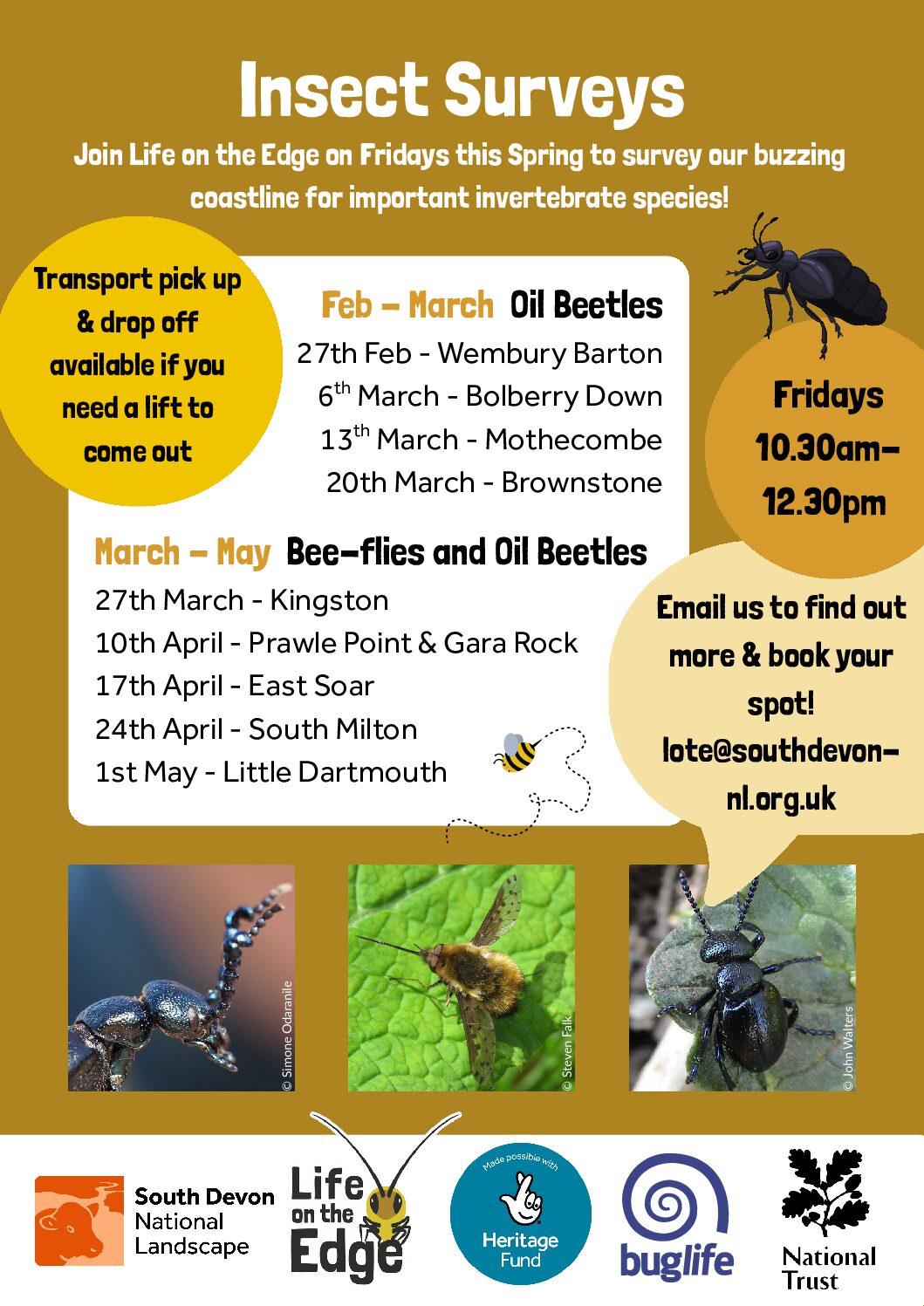
Come and join Life on the Edge this Spring to survey the invertebrates of our beautiful coastline and work on your insect identification skills! Starting on February 27th, we will be going out every Friday from 10.30am to 12.30pm to sites along the coast. We will start our survey season looking for the Black Oil Beetle and Short-necked Oil Beetle, and as the weather warms up will also survey for the Dark-edged Bee-fly and Dotted Bee-fly. These creatures are useful indicators of a thriving, species-rich coastal habitat ideal for numerous plant and insect species, so going out and recording is a vital element of our work to restore these habitats. Your survey results will be uploaded to iRecord, and will help us to target our nature restoration work to protect and grow their populations.
See below for dates and survey locations, and please get in touch for more information on meeting points and to book your place. We are providing transport in a 9 seater van for those that do not have their own transport, with pick-ups at Follaton Arboretum in Totnes and en route – please let us know when you sign up if you would like a lift and we will let you know further details. Sorry, but we are unable to take dogs in the vehicles.
This opportunity is open to anyone who has an interest in nature and our coastline, or wants to get more experience surveying the variety of nature on their doorstep 😊
Important booking information
- Free event
- Pre-booking essential via email to lote@southdevon-nl.org.uk – contact us to book and for more information on meeting point. Let us know if you would like to use the LotE transport.
Know before you go
- Fridays from 10.30am to 12.30pm
- Meeting point / location: See attached poster for survey locations, and email for further specifics on meeting points and lifts
- Walk distance: approx 3-5km
- Accessibility: this event is taking place on the unsurfaced footpaths and is not suitable for people who might have difficulty in these conditions.
- Sorry, no dogs
- To bring: weather-appropriate clothing, sturdy boots, snacks and drinks. If you have one, a hand lens and a note pad would be useful.
Black Oil Beetle & Short-Necked Oil Beetle
From early spring in South Devon, you can find three of the five native UK Oil Beetle species, Black Oil Beetles (Meloe proscarabaeus), Violet Oil Beetles (Meloe violaceus), and Short-necked Oil Beetles(Meloe brevicollis) . Both Black and Violet Oil Beetles are relatively widespread in South Devon, however their abundance does seem to be declining. However, the Short Necked Oil Beetle has a very restricted, fragmented range nationally, with it being equally rare in South Devon being known from one stretch of coast between Bolt Tail and Bolberry Down..
Violet Oil Beetles are often found inland in woodland edges, sunny glades, and hilly, unimproved grasslands, whereas Black Oil Beetles are more commonly found on coastal cliffs and open, sandy, or well-drained grasslands. To distinguish between Black and Violet Oil Beetles, examine the base of the thorax (pronotum). The Violet Oil Beetle has an indented lower edge with a distinct, sharp, raised tooth at the base. The Black Oil Beetle has an almost straight lower edge to the thorax with only a small, rounded, or almost absent tooth.
Black Oil Beetles have a square thorax and kinked antennae, and can be up to 30mm in length. Short-necked Oil Beetles are smaller, up to 24mm long, and have an oblong shaped thorax resembling a ‘short neck’ with shorter, straight antennae. Any records of the Short-necked Oil Beetle should be submitted to iRecord with a photo clearly showing the thorax (ideally a dorsal view, i.e. top-down of its back).
Black, Violet and Short-necked Oil Beetles are found from March through to June (although can be spotted as early as late February in the milder Devon climate) when the adults emerge to feed and mate. Look near wildflower-rich sites, patches of bare ground on the coast path that females will burrow into to lay their eggs, and grassy tussocks that can provide shelter on colder days. Their life cycle is intertwined with that of solitary bees, so any habitat that is good for solitary bees is a good sign there might be Oil Beetles nearby!
Dark-Edged Bee-Fly and Dotted Bee-Fly
Bee-flies, although they look like bumblebees, are actually flies. Their distinctive features are their fuzzy bodies, long tongues, and hovering darting flight. Their tongue – which can be almost half as long as their body – is technically called a proboscis, and is used to feed on nectar from flowers. A good way to tell different species of bee-flies apart is to look at the patterns on their wings. The Dark-edged Bee-fly (Bombylius major) is a widespread species to look out for in South Devon from March through to June, identified by the solid dark band along the front edge of their wings. A rarer species is the Dotted Bee-fly (Bombylius discolor), identified by the dark spots on the front edge of their wings.
During flight, identification is much harder as their distinctive wing patterning becomes a blur – so if you spot one still, snap a clear photo and upload a record to iRecord.
Dark-edged Bee-flies can be found throughout South Devon in a variety of open habitats, including gardens, grassland, woodland rides and clearings, and the coast. The Dotted Bee-fly has more scattered records, but is most commonly seen between Prawle Point and Start Point. Their life cycle is intertwined with that of solitary bees, so any habitat that is good for solitary bees is a good place to start looking!


Thanks to National Lottery players